
Out-of-Distribution Detection#
The concept#
The task of “Out-of-Distribution Detection” (or “OoD Detection”) is a particular case of novelty detection. It consists in identifying, at runtime, inputs for which a model’s prediction should be rejected, by lack of informed support. For example, if a Neural Network was trained to classify images of cats and dogs, it would seem irrelevant to trust its output on a tree image. Although there is no absolute definitive answer to this question (depending on the context, what a person considers OoD might be considered In-Distribution (InD) by another), it is still possible to perform deviation estimations through confidence scores.
In scio, we aim at performing OoD Detection naturally by thresholding confidence scores. That is, defining the following decision function for a given threshold \(\tau\):
Ultimately, the choice of threshold is a trade-off between False Positives and True Positives, left to the user’s responsibility. However, it may be relevant to compare score functions in their ability to offer good trade-offs. For example, imagine we have at our disposal \(X_{\text{InD}}\) and \(X_{\text{OoD}}\) corresponding to sets of samples which we know to be respectively InD and OoD. Then, we can evaluate score functions, say \(S_{\text{bad}}\) and \(S_{\text{good}}\), on those sets and plot the following histograms.
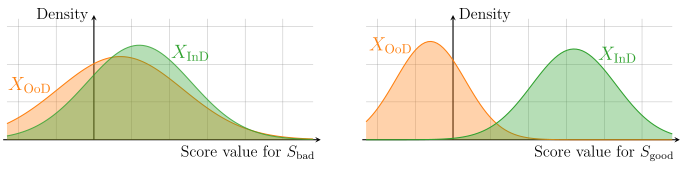
In this case, it seems clear that for the chosen InD and OoD representatives, \(S_{\text{good}}\) offers better trade-offs than \(S_{\text{bad}}\). In scio.eval, we provide tools and metrics to visualize and quantify such observations.
Application#
The ability to robustly identify Out-of-Distribution samples may have many useful applications. Simple examples are:
Monitoring. Using the OoD Detection as a reject option may help using safe fallbacks more efficiently for deployed models.
Training. Some training procedures may benefit from identifying samples for which a model is currently unfit to infer.